


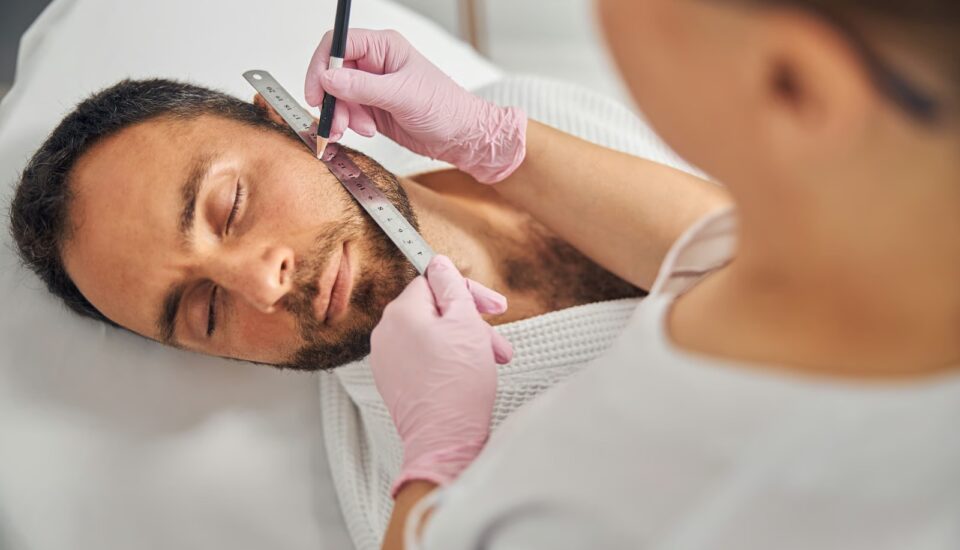
When Facial Hair Restoration Is Considered
Beard or moustache transplantation may be considered in cases of:
- Congenital absence or patchy facial hair
- Traumatic or surgical scarring
- Asymmetry or irregular growth patterns
- Previous unsuccessful facial hair procedures
Candidacy depends on donor availability, skin characteristics, hair calibre, and long‑term expectations.
Why Facial Hair Transplants Are Different
Key distinctions from scalp transplantation include:
- Far greater importance of hair direction and angulation
- Conservative density planning to avoid an artificial appearance
- Greater visibility of errors due to facial anatomy
- Significant variation in growth patterns between individuals and ethnic backgrounds
Small design errors are far more noticeable on the face than on the scalp.
Design, Density & Natural Appearance
Natural facial hair outcomes depend on:
- Correct border and contour definition
- Gradual density transitions
- Accurate directional flow
- Respect for facial anatomy and symmetry
Over‑dense or poorly angled grafts lead to unnatural outcomes that are difficult to correct.
Donor Considerations
Donor hair for facial restoration is typically sourced from the scalp.
Clinical considerations include:
- Matching hair calibre and texture
- Preserving donor reserves for future scalp needs
- Long‑term planning, particularly in younger patients
Donor preservation remains a non‑negotiable principle.
Expected Outcomes
Facial hair transplantation aims to achieve:
- Natural‑appearing coverage
- Improved symmetry and definition
- Integration with existing facial hair
It does not aim to recreate extreme density or artificial uniformity.
When Facial Hair Transplantation Is Not Advisable
Surgery may not be appropriate when:
- Donor reserves are limited
- Expectations are unrealistic
- Skin or scarring conditions impair healing
In such cases, restraint represents appropriate clinical judgement.
Relationship to the Hair Restoration Pillar
Facial hair restoration sits within the broader Hair Restoration domain but is managed as a distinct aesthetic and technical category.
Overall philosophy, donor management principles, and long‑term planning are outlined in the Hair Restoration Pillar.