

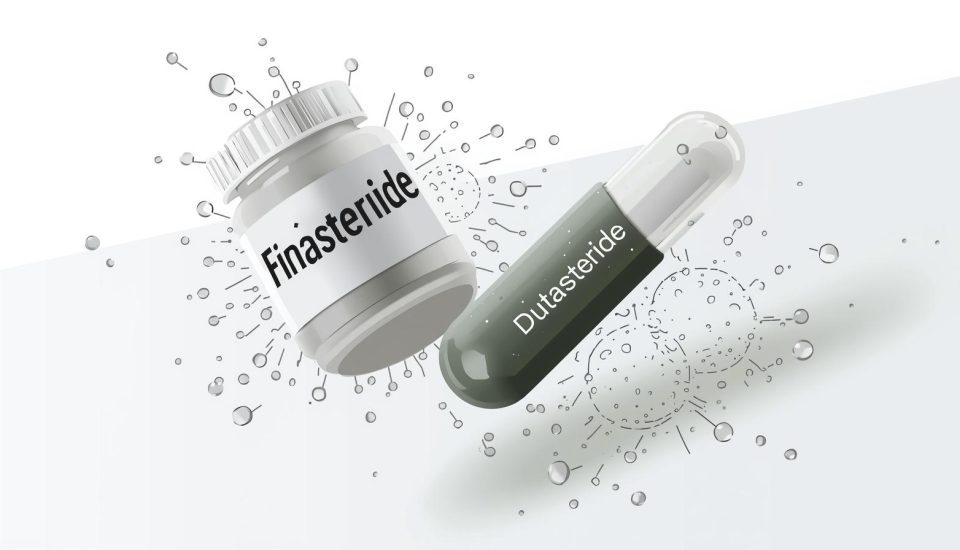
What Are Finasteride and Dutasteride?
Both medications inhibit the enzyme 5-alpha-reductase, which converts testosterone into DHT.
- Finasteride inhibits type II 5-alpha-reductase
- Dutasteride inhibits both type I and type II isoenzymes
By lowering DHT levels, these medications may reduce androgen-driven follicular miniaturisation in susceptible individuals.
How These Medications Work — and Their Limits
By suppressing DHT, finasteride and dutasteride reduce one hormonal signal involved in hair follicle miniaturisation.
However, it is important to recognise their limitations:
- They do not create new hair follicles
- They do not reverse advanced hair loss
- They do not address non-androgenic contributors such as inflammation, nutritional deficiency, or metabolic dysfunction
Their effect is suppressive rather than restorative.
Potential Benefits
In appropriately selected patients, these medications may:
- Slow progression of androgenetic hair loss
- Preserve existing hair density
- Support other treatment strategies in selected cases
Any benefit depends on continuous, long-term use.
Risks and Side Effects — Why Caution Is Required
DHT plays physiological roles beyond hair follicles, including sexual function, neurosteroid balance, and hormonal signalling.
Reported side effects may include:
- Reduced libido
- Erectile dysfunction
- Ejaculatory changes
- Mood changes or depressive symptoms
- Cognitive or emotional blunting in some individuals
In a subset of patients, symptoms have been reported to persist after discontinuation, a phenomenon commonly referred to as Post-Finasteride Syndrome (PFS).
Because individual susceptibility cannot be predicted reliably, these medications should not be used casually or reflexively.
When These Medications May Be Considered
Finasteride or dutasteride may be discussed when:
- Androgenetic hair loss is clearly diagnosed
- Hair loss is progressive and early to moderate
- The patient fully understands potential risks and limitations
- The psychological impact of hair loss is significant
- Alternative or adjunctive options have been explored
Shared decision-making is essential.
When These Medications Are Not Recommended
These medications are generally avoided when:
- Hair loss is non-androgenic
- Concern about sexual or psychological side effects is high
- There is a history of mood disorders sensitive to hormonal modulation
- The expected benefit is small relative to potential risk
Maintenance and Discontinuation
The effects of androgen suppression persist only while treatment continues.
If medication is discontinued, DHT levels return toward baseline and hair loss typically resumes according to the individual’s natural pattern. This represents loss of suppressive effect rather than rebound worsening.
Frequently Asked Questions
Q1 :Do these medications regrow lost hair?
No. Their primary role is slowing further loss rather than restoring hair where follicles are no longer viable.
Q2 :Is dutasteride stronger than finasteride?
Dutasteride suppresses DHT more broadly. This may increase efficacy in some patients but also increases potential risk.
Q3 :Are side effects common?
Most patients tolerate treatment, but side effects are well-documented and unpredictable, which is why careful selection matters.
Q4 :Are these medications necessary if I plan surgery?
Not necessarily. Surgical planning can often proceed without androgen suppression when donor management and expectations are appropriate.
Q5 :Can these medications be stopped safely?
They can be stopped, but any protective effect on hair is typically lost over time. In some individuals, side effects have been reported to persist after discontinuation.
Considering Androgen Suppression?
If you are considering finasteride or dutasteride, a physician-led consultation is essential to weigh potential benefit against individual risk.